
Is World Peace a Total Utopia, or an Achievable Goal?
2026-09-11 | reading time: 6 minutes | critical thinking, equity seeking, system, world peace
57 years ago, the first human stepped on the moon. Currently, we are planning to build cities on Mars. We created planes and ships that connect the whole world physically, and networks that connect us mentally. Over the last 50 years, humanity went from searching for information on library shelves and in card catalogues for hours to asking AI a question and receiving an answer within seconds. Meanwhile, we are overloaded with negative news, and statistics show that world peace is declining.1 Violence cost the global economy roughly $21.8 trillion in 2025, about 10.5% of the entire world's economic output, in other words $2,657 for every person on the planet. That's not an abstraction. It's schools not built, hospitals not staffed, and years of ordinary life spent instead on managing conflict. New technology is accelerating the slide: drone attacks rising, and AI has compressed some targeting decisions from a full day down to seconds, far faster than international law or diplomacy has been able to adapt.2How is it possible that we seem so developed, cooperating on such a large scale, and still struggle to live peacefully?
No wonder that if I talk to people about world peace I mostly receive very pessimistic reactions. Even I feel a bit cringe when I use the words “world peace”, like a naive kid romanticising the world. But the more I use it, research it, and write about it, the more I notice my perspective shifting. Let me tell you why.
À la Socrates, I'd like to first clarify what PEACE actually is.
I personally used to think of peace as a state of harmony in the absence of hostility and violence. Which I learned is called Negative Peace. It is argued as fragile by design, because it can be shattered by a single actor with a single grievance.
So called Positive Peace, on the other hand, is a deeper, structural peace that includes social justice, equality, effective and transparent institutions, and respect for human rights. Positive peace prevents violent conflicts from reoccurring in the first place. Perhaps it's better understood as a system that has to be continuously maintained, not a state you simply arrive at.3
Why Negative Peace Breaks Down
Researchers studying the causes of war often point to what's called the “Triple-R” concept: Reasons to fight, such as grievances or political goals. Resources and opportunities to wage war. Resolve to choose violence despite its costs.4 It all starts with a reason, and those are usually failures of positive peace. Oh my friend, there are many to choose from.
The range goes from material ones such as competition for territory and resources or economic interests, in other words MONEY.
To ego-led reasons, including (political) power, status, revenge, leaders’ incentives, humiliation, ideology, and nationalism.
Over leak of empathy, the disconnection between those who decide to fight and those who actually die for it is huge. An unnatural small number of people have a huge responsibility for many people they can not be emotionally connected to all of them, that’s just impossible. I wonder: What would conflict resolution look like if the mothers of those who’d have to go into a deadly battle were the ones negotiating with one another?
There are also biology-driven reasons, everything that is connected to emotions like fear, uncertainty and misperception: What if the other side isn't following the peace agreement and attacks us even harder, shouldn’t we strike first?
We also have systemically errors like inequality, historical grievances, security dilemmas, institutional failures.
Last we have the tools: Propaganda such as creating an us-vs-them mindset and dehumanisation to convince the mass, that violence is justified. And the inability to resolve conflicts peacefully.5
The causes are different, but they’re connected to the way humans organize themselves. Which raises the question: Why do societies repeatedly create conditions in which violence becomes possible or attractive? Is it because we focus as humanity on the wrong goals? And what are the right ones?
The Potentially Right Goals
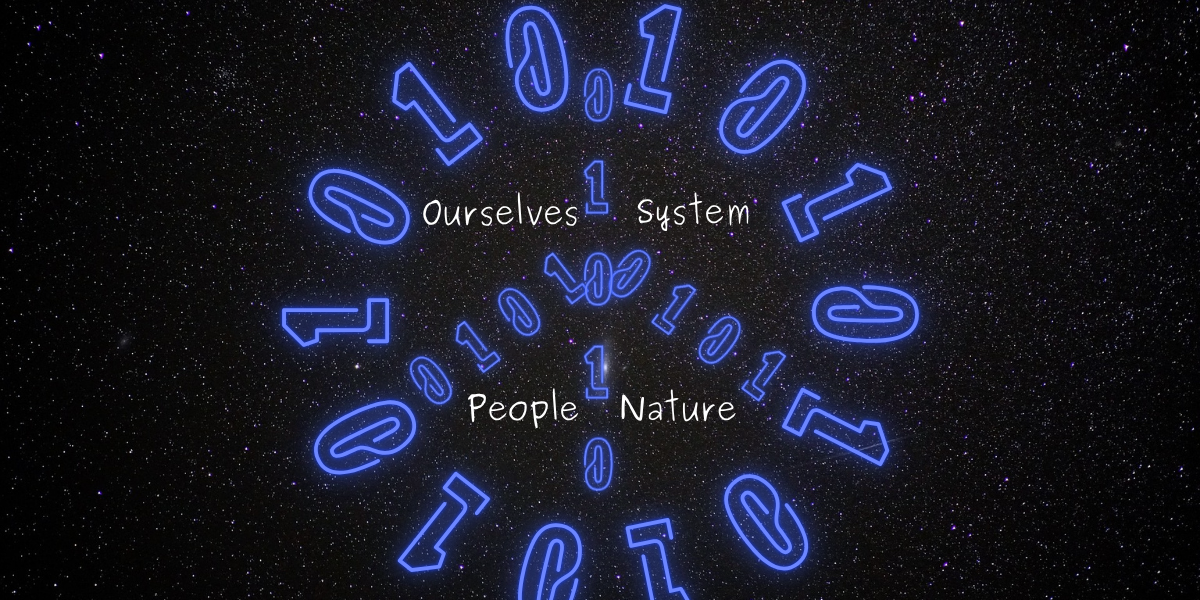
1. Peace between People
There are endless different cultures, opinions, rules and mindsets: It’s impossible to get them all to agree. We won’t eliminate conflicts but the way we handle them can change. For example, by actively practicing taking another person's viewpoint during a disagreement. It's very human to feel more drawn to people who are similar to us. Embracing and tolerating difference is a rewarding art.
In any conflict we shouldn’t forget and this is crucial! There is no excuse for violence, neither physical nor verbal. We’re all homo sapiens, not in the same situations, but we all feel the same pain, happiness, sadness, anger, frustration, fun and so on.. Because 99,9% of our DNA is identical, no matter how we look or which values we follow. Isn’t that enough similarity to move from us vs. them to shared problem-solving?
2. Peace with Nature
We all need oxygen to breathe, water, food, sun and healthy soils to survive. If we don’t nourish what keeps us alive, we risk our most basic needs and that leads to more conflicts. Somehow humans became so disconnected from what actually nurtures our being. How many of us have planted a seed, watched it grow, a little more each day, and impatiently waited to eat the fruit the plant produced?
I grew up learning that you need money to buy food, instead of a seed, healthy soil, and the right amount of water and sun. We learned to worship money more than the complex system that actually brings the food to us.
Maybe our mindsets are very different, but our biology is the same. So shouldn't it be a central goal for all of humanity to keep those resources as available as possible, for as many generations as possible, in as great an abundance as possible?
Let’s take water, which is obviously a shared need, as an example:
Problem:
- Salt water (non drinkable water) is rising while freshwater is shrinking. Melting glaciers and ice sheets add water to the ocean, so sea levels rise, and the salt water pushes inland, intrudes into coastal aquifers and river deltas and contaminating freshwater sources that used to be reliable.
- Underground water reserves drawn down far faster than they can be refilled.6
- Rivers don’t know borders so managing them separately can benefit one country's economy (for example, through a dam that generates electricity) while the next country downstream receives significantly less water, endangering its people's lives.7
- Water pollution, which is happening often through industries, such as chemicals in cloth production and gold mining.
- Water ownership became institutionalized.
A shared goal for every single human, could therefore be clean and enough water for every organism. The issue who pays for it? Which brings us to the next point.
3. A Peaceful GLOBAL System
If the system would reward clean rivers and social acts, humans would probably put afford in it. Any system we live under, political or economical were made by people, for people. What a coincidence, we are people, so we can change and shape them. Like anything, there are pros and cons, but maybe now it’s time to shift from domination towards cooperation: a mix of all the systems we already have, some that have been forgotten, and maybe some new ideas altogether. One that creates conditions in which people feel safe enough to cooperate. One that asks “How can we feed everyone?”, “What’s best for our rivers?”, or “How can we regenerate our soils?” instead of “How can we raise our profits?” or “How can we increase dividends for our investors?”
There’s a wide variety of approaches here. I'll be writing a separate blog post about this. Send an Mail or follow me on social media if you don't want to miss out.
4. Peace within Ourselves
All of the above starts with you! It’s a mindset, a will, a constant effort. A state of mind that mirrors in our actions. It starts with self compassion, self respect and self love (just enough not to tip into narcissism). I believe some of the key elements are learning how our brains work, observing ourselves and our reactions, and realizing how many linked chains led us to where we currently stand in life and mindset. Understanding our emotions and practising how to stay calm when we feel threatened or angry, so we can respond instead of react.
If enough people commit to that inner state of peace, despite all the noise, we can spread this energy like fire through a dry forest. We can burn down hate with love.
One way to find inner peace is through meditation, fasting, and gratitude. We’re all so individual that everyone takes a different path toward inner peace. The final boss is staying peaceful even when we’re surrounded by hate and negativity.
Conclusion
World Peace is not a new idea, in 1971 John Lennon was already imagining all the people, living life in peace. However I believe we now have a new variable that makes it more realistic than ever before, while putting it more at risk than ever too. TECHNOLOGY. Humanity can use it to control certain groups, build better weapons, manipulate, and spread hate or misinformation. Or we can use it to connect people around the world, build foundations for equality, help each other through open sources and work towards shared goals. Because I genuinely believe most of us want world peace.
We need enough people to believe in something to keep it alive. Therefore we just need enough people who believe in world peace beside all this noise, hate and propaganda out there. Which means we need you!
World Peace is something that has to be built and nourished which is exactly why it’s an achievable goal.
1. The Global Peace Index 2026 shows that world peace has been continuously declining since 2014. It's measured across 23 indicators within three domains: Ongoing Domestic and International Conflict, Societal Safety and Security and Militarization
2. Global Peace Index 2026
3. Johan Galtung, a Norwegian sociologist and peace researcher, 1969 paper, Violence, Peace, and Peace Research (Journal of Peace Research, Vol. 6, No. 3)
4. Same as number 3
5. Those are generally formed issues, I don’t wanna bring up examples at this point as it would go beyond the scope. The categorisation was made by my observation of current and past wars plus the inspiration of those sources:
Secretary-General's remarks to the Security Council on prevention of conflicts in Africa: Addressing the Root Causes
Christopher Blattman’s Why We Fight: The Roots of War and the Paths to Peace (2022)
6. Irvine, Calif., 2015: A third of the world's biggest groundwater basins are in distress
7. Sophie de Bruin, 2023: 920 million people could face conflict over the world’s rivers by 2050: what our study found in Africa
YANUNI | Inside the Battle for the Amazon | Oscar® Shortlisted Documentary Feature Film
Elif Shafak, 2024: There Are Rivers in the Sky