
Your truth is not THE truth
2026-01-19 | reading time: 10 minutes | brain, mindset, truth, flexible thinker, peace, understanding
What traditions around the world teach us
We are travelling back in time, long before our brains were overloaded 24/7 to look at some wisdom shared across cultures.
~380 BCE, Greece: Plato’s story of people chained inside a cave. The shadows they saw were reality for them, until they broke free.
~800–200 BCE, Hindu traditions: Māyā (Sanskrit for “Illusion”). They warned that what we see with our eyes can mislead us, and that deeper truth requires looking beyond appearances.
~55 CE, Bible: Paul wrote, “For now we see in a mirror, darkly, but then face to face: now I know in part, but then shall I know fully even as also I was fully known.” reminding believers that human understanding is partial.
~610–632 CE, Qur’an: “Truly, it is not the eyes that are blind, but the hearts which are in the breasts that grow blind.”
Ghana: “Wisdom is like a baobab tree, no one individual can embrace it”
China: “There are three truths: my truth, your truth, and the truth.”
📝 Did you grow up with one of these sayings? Do you have a similar message in your culture? What does it mean to you?
What philosophers, various religions and traditions have assumed for centuries, we can now back up with science. It has been around for so long, and yet I feel it is drowned out by noise. Your truth is not the truth! Understanding and accepting this is, in my opinion, one of the most important teachings for humanity if we want to create a peaceful world.Let’s dive into it:
Perception and perspective explained
Perception means the way our brain processes raw data from the senses.
The five typical senses are seeing, hearing, touching, smelling, and tasting. But we have three more that affect our perception: our sense of balance, our awareness of body position, and our inner body signals (like hunger or heartbeat). Even those raw data are already selective, our senses only pick up a small part of reality.
The personal interpretation and meaning we attach to those data depends on many factors, such as our emotions, personal biases, culture and past experiences. This is called perspective.
Let’s break this down with an example, “Inspired by Goldstein’s Sensation and Perception” Look at the picture, take a moment to think about what you see, maybe write it down.
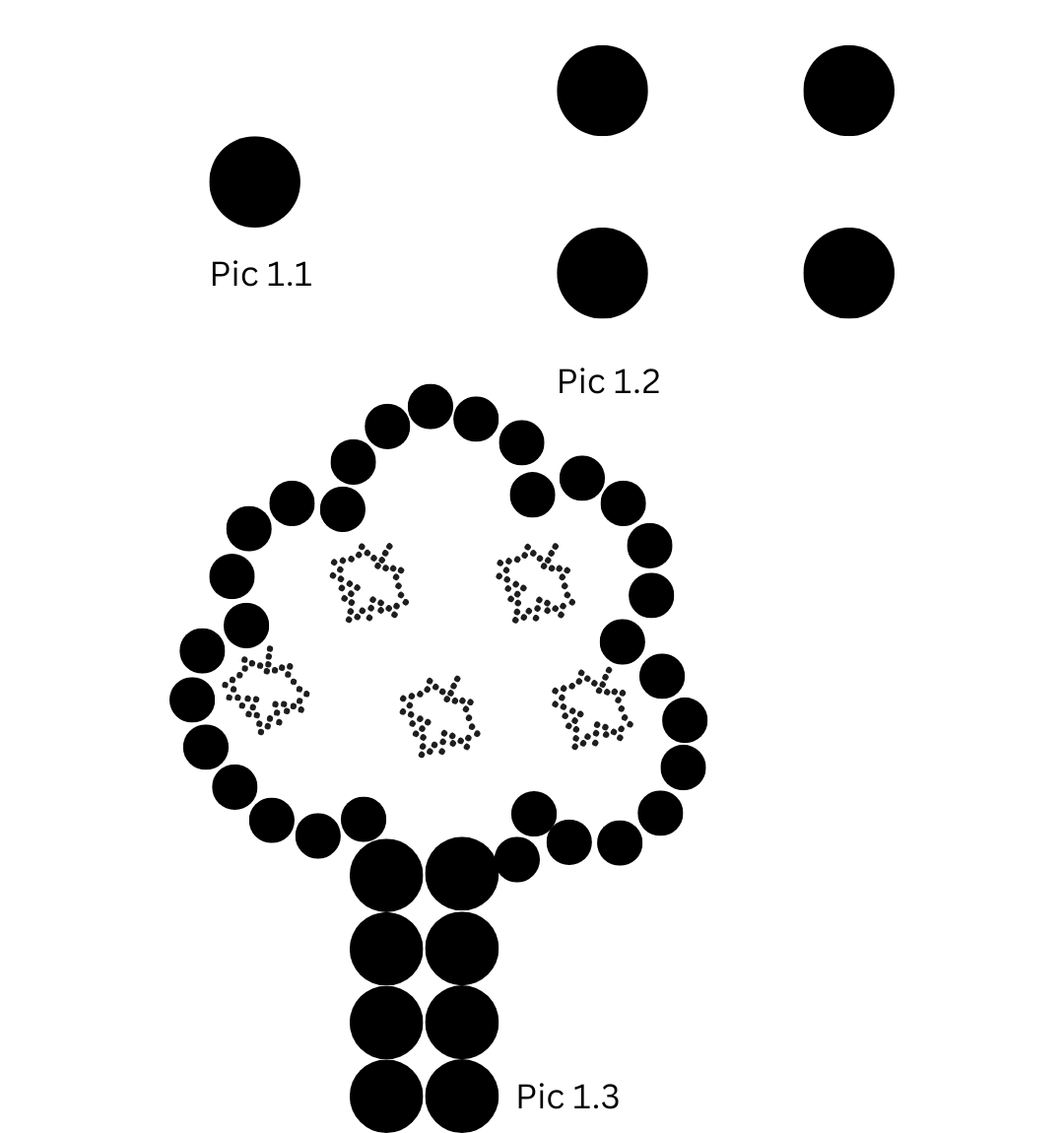
In pic 1.1, you perceive a black dot through your sense seeing, not much variety included.
In pic 1.2, you see four dots. This seems like a shape some people might identify it as a square. You added knowledge, and therefore perspective.
Pic 1.3 includes many dots and requires knowledge to identify it as a tree, maybe the knowledge is enough to define the tree as a maple tree. Some people see a simple tree no deeper perspective included. Others might see it as a disturbing thing that takes up space and loses leaves, creating a mess. For others, it is pure beauty. Some see a useful resources to create syrup or firewood. While others see an ecological necessity that produces oxygen, contributes to a healthy soil and protects other plants.
Perspective is endless.
If you look now again at pic 1.1, the simple dot, WAIT it might be a black hole instead! Even something that seems as simple as a dot leaves room for different perceptions.
📝 Now transform this to emotionally charged events… Do you remember a moment when you talked with someone and felt like you were living in two different worlds? How did that situation made you feel?
Limits of our brain
Scientists agree that what we call “truth” is only part of a larger picture, the spectrum is debated. Some argue, that your slice of truth is accurate enough otherwise you could not function. Others suggest that your slice of truth is not reality at all, but a useful illusion.
Human senses are limited! For example, we do not see ultraviolet, bees do. We can not hear frequencies as high as bats or dolphins, or as low as elephants. Nor can we smell as well as dogs.
What we call “the world“ is, in fact, a tiny, filtered slice of physical reality. Even within that slice, the brain improvises. There is a visual blind spot in our vision that we do not notice because our brain automatically fills in what is missing.
Ready for an experiment?
In which direction does the animation turn for you?
What if I tell you it can spin in both directions? Yes, it is true! Relax, take a couple of deep breaths, focus, and believe that the animation can spin in the other direction.
It is a 2D shadow animation with no depth cues. Our brain fills in the gaps and tricks us into perceiving ambiguous 3D motion. It is a powerful metaphor for how our brain processes information.
The shape of our personal truth
Perception is the raw data.
Perspective is the meaning we attach to it.
Influences include:
- past experiences
- emotions
- personal biases
- cultural background
- social environment
- educational system
- language
- expectations
- values
- memories
Emotions evolved to help us survive. Fear alerts us to danger. Disgust protects us from spoiled food. These mechanisms once kept us alive. Today, however, we live in a world where we are constantly exposed to media designed to trigger emotions. Our brains are especially sensitive to emotionally negative information and are more likely to remember it. When messages are repeated often enough, they begin to feel true, even without evidence.
Emotional states also shape perception. Anxiety, for example, can cause people to interpret neutral faces as threatening.
On top of this comes confirmation bias. We like being right and our brains reward it. Once an opinion is formed, the mind automatically searches for information that support this truth while ignoring what contradicts it. Gaps are filled with what we expect to be true rather than with what is actually there.
📝 Where do you see confirmation bias in your own thinking? What patterns keep repeating?
Why this matters for peace
What we can agree on is, perception is not reality it is built, then my truth is not necessarily your truth. Two people can witness the same event and genuinely experience it differently. This is not dishonesty or disrespect, it is how human cognition works. Our brains are storytellers, and each story is slightly or largely unique. When we forget this, disagreement becomes moral judgment. When we remember it, disagreement becomes dialogue.
A way forward
Challenge your beliefs. Question deep and a lot. Listen actively and try to truly understand different points of view. Make sure your information comes from various sources. Differentiate between facts and opinions. Try to cut through the noise. And the next time you disagree so strongly with someone that you want to scream, remember to stay calm and think of truth as a mosaic: each person adds a tile. Stay humble yet confident. This is exactly the moment that can help you grow.
📝 What sources shape your worldview? Do they come from one bubble or many? Can you disagree and still remain respectful? What could you add to your life to let your perspective grow?
Some sources used and worth to check out:Pesos et al., 1998: Finding out about filling-in: A guide to perceptual completion for visual science and the philosophy nof perception
Goldstein and Cacciamani, 2021: Sensation and Perception, Eleventh Edition
SonyVisual_Hungary: Video of optical illusion cartoon
Troje and McAdam, 2010: The viewing-from-above bias and the silhouette illusion
Selective attention test
Bishop, 2007: Neurocognitive mechanisms of anxiety: an integrative account
Loftus, 2005: Planting misinformation in the human mind: a 30-year investigation of the malleability of memory
Nickerson, 1998: Confirmation Bias: A Ubiquitous Phenomenon in Many Guises